
 Back to main menu
Arthur Grimes has been awarded the New Zealand Association of Economists Distinguished Fellow Award
Jul 6, 2026
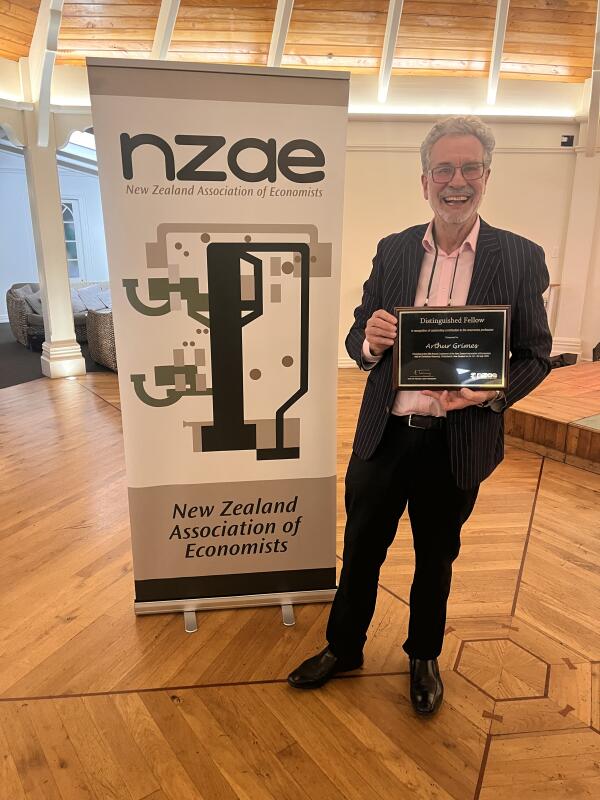
In a mark of recognition for a career dedicated to supporting better outcomes for communities, Te Herenga Waka—Victoria University of Wellington’s Chair of Wellbeing and Public Policy, Professor Arthur Grimes has been awarded the New Zealand Association of Economists Distinguished Fellow Award.
The award recognises economists in Aotearoa New Zealand who have made a significant contribution to the development of economics and is the highest honour bestowed by the Association.
Out of the various awards Arthur has received throughout his career, he says this one means the most to him.
“This recognition from my peers is a highlight of the almost 50 years I have spent as a professional economist.”
Associate Professor Barbara Allen, Head of the School of Government at the Wellington School of Business and Government, says Arthur has been a stalwart member of the School of Government for many years.
“Arthur continues to exemplify the goals of the School, showing research excellence, commitment to engagement and teaching, and the willingness to expand the horizons of economic debate.
“This award demonstrates the highest level achievement and regard, both internationally and nationally.”
Before discovering economics, Arthur wanted to pursue politics but realised that “one needed to understand economics to be a capable actor in the political space”.
“Once I studied economics, I gained a much fuller appreciation of the trade-offs that all decisions entail,” he says.
“Politicians’ lack of understanding of these trade-offs and of the unintended consequences of many of their policies, made me decide not to enter politics but instead to work on researching and implementing policies that enhance people’s lives without having the pressure of political arguments affecting recommendations.”
He says that economists tend to look at the world as it is, whereas politicians tend to look at the world as they would like it to be.
“I like to look optimistically as to how we can improve quality of life, especially for the disadvantaged amongst us, but always with recognition of real-world constraints so that fanciful policy options are ruled out.”
Arthur’s academic journey began at Waikato University, where he completed his undergraduate degree before completing both his Master of Science (Distinction) and PhD at the London School of Economics.
During his studies he was awarded the Ely Devons Prize and the Robert McKenzie Prize, as well as the Sayers Prize in monetary economics from the University of London.
“My PhD supervisor, Professor Sir Christopher Pissarides, subsequently won the Nobel Prize in Economics—I was very lucky in having people of this calibre teaching me,” he says.
Arthur’s relationship with Te Herenga Waka began in the late 80’s where he taught graduate macroeconomics and monetary economics part-time. He soon became the director of the University’s Institute of Policy Studies.
Throughout the following years, Arthur’s career weaved through academia, public policy, and work within the private sector. He says those experiences contributed to his academic work in the public policy field.
“I have always been interested both in academic topics and in policy. The balance of my work has shifted back and forth between the two spheres over time, hopefully enriching both aspects.”
Arthur returned to the University in 2016 as part of the School of Government where he now specialises in research aimed at improving people’s subjective wellbeing—how they feel about their lives as a whole.
“I am very lucky to be able to research and teach in fields that are meaningful to me,” says Arthur.
“I work with colleagues across several schools and faculties in the wellbeing space—including from disciplines as diverse as education, geography, and of course economics.
“I have always had a multi-disciplinary perspective, from my undergraduate days onwards, so it is wonderful to be able to discuss policies with researchers and students from many different backgrounds.”


