
 Back to main menu
Webinar: Scoping NZ ETS and removals pathways for better climate and nature outcomes
Nov 26, 2026
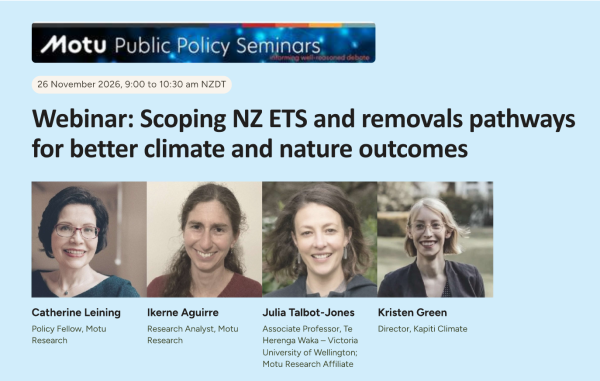
Join us for a free Motu Research public policy webinar on "Scoping NZ ETS and removals pathways for better climate and nature outcomes".
The New Zealand Emissions Trading Scheme (NZ ETS) is not fit for purpose to manage the challenges ahead and must evolve. This webinar marks the launch of a new Motu Working Paper that explores how combining NZ ETS reform with a new Removals Investment Mechanism (RIM) could send clear long-term investment signals to emitters and foresters, help meet Aotearoa New Zealand’s climate targets, and deliver better outcomes for nature.
Waiting beyond 2030 to improve the NZ ETS could lock in misdirected investment and cost the Government around NZ$11–12 billion in auction revenue through to 2035. To avoid market disruption, government decision-making should be staged carefully, supported by inclusive processes, and concluded well in advance of implementation.
In the webinar, the four authors of the paper will present research highlights on:
- Why NZ ETS reform is essential and how the introduction of a RIM could help
- What insights surfaced from scenario analysis across multiple models
- How a more integrated approach to compliance and voluntary markets could boost investment in climate and nature
- What other advanced economies are doing to upscale removals.
The Motu Working Paper, Scoping NZ ETS and removals pathways for better climate and nature outcomes (which will be released on 26 November 2026 on the Motu Research website), is accompanied by a summary for policymakers and a technical modelling insights brief. The research was funded by the New Zealand Climate Foundation, NEXT Foundation, Tindall Foundation, and Sustainable Business Council. All views are the authors’ own.
You can attend this seminar online. We will provide the recording and slides afterwards.
When: 26 November 2026, from 9am-10.30am NZDT
Where: Zoom webinar link
Register: click here to register
About the speakers
Catherine Leining, Motu Policy Fellow, has over 30 years of international experience in climate change and environmental policy. She leads Motu’s research and engagement programme on Shaping New Zealand’s Low-Emission Future and provides consulting through Silver Lining Global Solutions (SilverLiningGS.com). She served as a Commissioner at He Pou a Rangi Climate Change Commission (2019–2024) and supported the UN-based Taskforce on Net Zero Policy as a member of the Taskforce Expert Group (2024–2026). In government roles, she served on the New Zealand delegation to the UNFCCC negotiations and helped design the New Zealand Emissions Trading Scheme.
Ikerne Aguirre, Motu Research Analyst, has an interdisciplinary background. She holds a BSc in Oceanography (UABC, Mexico) and an MA and PhD in Human Geography (University of Otago). For over 20 years, Ikerne has worked on projects combining sustainability, conservation, governance, and multicultural and cross-national comparisons. Her research experience spans energy, food, agriculture, and environmental practices and education.
Kristen Green, Director of Kapiti Climate, is a climate change economist based in London who spent ten years working on climate policy for the New Zealand Government. At the Ministry for the Environment, her advice supported the Government's decisions on New Zealand's first Paris Agreement target. At the Ministry for Primary Industries, she worked on policy for pricing agricultural emissions and advised Ministers on the design of the NZ ETS and its forestry rules. Since 2024, she has worked on carbon markets and climate policy through her consultancy for public bodies, investors, traders and businesses across North America, Europe, New Zealand, and the Asia-Pacific. She also writes about carbon markets and climate policy on Substack.
Julia Talbot-Jones, Associate Professor at the School of Government at Te Herenga Waka – Victoria University of Wellington, is a Motu Research Affiliate. Her research investigates how institutions can be designed, or evolve, to solve environmental and natural resource problems over time, particularly in the context of freshwater and at the nexus of biodiversity and climate.
Motu Public Policy Seminars are free to the public, but please subscribe to receive email notifications of Motu Research's events and publications.
Thanks to The Treasury NZ and Russell McVeagh for their generous support of our seminars.


